
News About the Project
Over the last few days it has been busy. At the weekend there was a conference of the Advanced Steam Technology Trust at Pickering and Grosmont on the NYMR. On Saturday we had some thought-provoking presentations as heat exchange in the firebox and fluid dynamics of the exhaust. The highlight was the ride to Grosmont to hear about oil firing of their S 160 Omaha, and to see the system at work as it was lit up. No brick arch, no ash, and no spark throwing, and much cleaner too. This system will be one to watch. Thanks to the NYMR for their hospitality, we were very well looked after.
On Tuesday it was off to Tyseley for the six-monthly meeting of the Main Line Steam Builders Group, where again there was much useful information exchanged.
On the home front we have been commissioning our new computer. It works brilliantly, thanks to our local IT man Martin of Cubit Computers in Derby. Our cylinder models are now good and the tedious but vital process of checking is underway.
On the locomotive we have been developing our process for the accurate reaming of the hornblock holes and some new fixtures are being made up.
We spent today developing our process for reaming out precision holes for the drive fit bolts to secure the hornblocks to the locomotive’s frames. Sadly we haven’t managed it yet. However we do think we have a way to do it, which we will try next week.
Our new computer is now with us thanks to Cubit Computers of Derby. Loading everything on to it is the present challenge, another way to while away the hours. It’s getting there, the zipped CAD software was a big download at 15GB, and will be installed once the Microsoft can be persuaded that it’s not a virus.
At the weekend there is an event for the Advanced Steam Technology Trust at Pickering, including a trip on the NYMR to Grosmont. It promises to be an interesting weekend. On Tuesday we are at Tyseley for the Main Line Steam Builders’ Group which is a most helpful event.
More news next week.
A glorious afternoon in Kirkby in Ashfield, checking out our trailing hornblocks and carrying out a trial fit. While we were at it we removed the driving horblocks to clean up the interfaces where they hadn’t quite made the desired snug fit. All four are now fitted very snugly with temporary bolts. We don’t intend to take them down again, the next operation is to ream out all the bolt holes to an exact size before fitting drive fit bolts. Once that is done we can erect the footplating and other platework.
Our engine is now about 20% complete by weight.
As ever, the tent that is our engine shed needed some attention to give it a better chance when the likely equinoctal storms arrive.
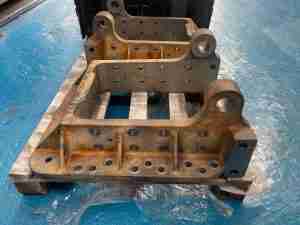
Our long-awaited Trailing Hornblocks arrived this morning. We look forward to carrying out their trial fit, which may be a week or two off due to diary commitments.
Another significant step towards building this magnificent locomotive, thanks to all our donors.
Good news, CAD design on the cylinders is moving again. Some clearing out of unwanted files and programs has probably helped, as has trying a few alternative ways of doings things. The computer still needs an upgrade anyway, as our model is getting larger all the time as it includes more and more parts. The view below shows the 2 ton cylinder block as ithe model shows it today. There is more work to convert the model to drawings, create a checking sheet thoroughly check it. We can’t afford any mistakes, it is a very expensive component, so best not to be in too much haste.
There should be more news on physical progress very soon.
Thank you all for your support, it is much appreciated and every little donation brings closer the day when we have a new loco taking to the rails with a good head of steam.

LEAD Technologies Inc. V1.01
Last Saturday and Sunday the Trust was at the Barrow Hill Roundhouse Bricks in the Roundhouse event. As ever, the Barrow Hill team were excellent, great people. It was stunning to see so much Lego, on some huge displays. One model had 6 trains all on the move at once. We met some interesting people and picked up a few ideas.
Our team had a good day at Chasewater on 1st August, so we are off to exhibit at Barrow Hill Roundhouse next Saturday 29th August and Sunday 30th August. It’s all about railway stuff and Lego stuff, we aren’t sure about the latter but maybe some of you out there can help us old codgers. Barrow Hill is always worth a visit, with or without Lego so do please come if you can. We will be very pleased to meet you and talk locomotives with you. Of course our focus is on No 2013 Prince George and the build progress.
Sadly, our design work on the cylinders has come to a shuddering halt as our Engineer’s computer says no; it can’t cope with the complexity of the CAD model. It should only be a week or two till it is upgraded with yet more memory and possibly a graphics card. September should see real progress on both design and assembly.
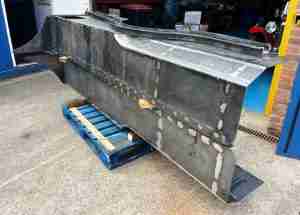
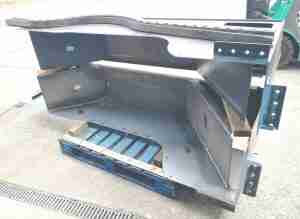
Eagle Fabrications have completed our cab splashers. The left photo shows the external view. The right side one is on top with the front end at bottom right of the photo. When turned 90° clockwise, it will fit in the front of the outer cab side sheet. At the top left is the profiled cab rear plate. Giving clearance to the firebox ogee curve requires the angled plate. Clearances between the splashers, driving wheels and the firebox are pretty complex in this area. Angled plates forming the actual splasher are shown on the right photo. There will be quite a bit of work to fit these to the cab outer panels.
Profiled plates are on their way for the right hand side coupling rod splashers. Once a trial fit of all these parts has been carried out they we all be sent off for grit blasting and painting before being permanently fitted to the frames.
Two other news items: our trailing hornblocks are almost finished, and delivery is expected early in August. Connecting Rod forgings are on order, and their will be an opportunity for a one or two members to witness this quite spectacular process. Once we have a date we will put the available places out to auction amongst our members. Eligibility might be a good reason to sign up for a minimum of £5/month!
It’s expensive building a locomotive, please consider becoming a member. These days £5/month is only a monthly pint of beer, so go on you can afford it! Please sign up to join: https://www.zeffy.com/en-GB/donation-form/donate-to-build-prince-george. If that is too complex just search Zeffy Prince George. It only takes a minute or two.
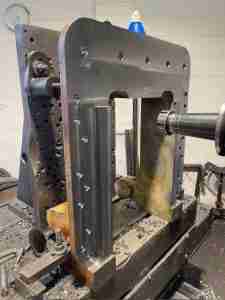
After a long wait, it seems that two more meaningful deliveries can be expected this month. Our trailing hornblocks are seen being machined, although there is still a lot to do. The main horn faces have to be machined, and eight bolt holes drilled in each face. As well as that Eagle Fabrications tell us that the cab splashers and associated parts will be ready this time next week.
Somers Forge are planning the forging of our connecting rods, so we will probably have a date for that very soon.
Finally, the right hand side coupling rod splasher will start production soon with the first step being the laser-cut steel plate profiles.
While we can expect limited progress in August as people take their holidays, after that we will have plenty to do with reaming out the hornblock holes and assembling the cab splashers into the outer cab panels.

At long last we have the modified cab support brackets back. In the photo above the large cut-out in the top plate is wide enough to accomodate the full width of the driving wheel, while the plate below it has a much smaller cut-out to clear the flange. Four bright steel buttons in the vertical plate are stepped on the outside diameter with the smaller diameter locating in a 40mm diameter hole in the plate. The button is bored to take a countersunk head M24 bolt. It all looked good, so we fitted the two up to the dragbox at the rear of our loco, see below. The holes lined up, and so did the top and rear faces. Success!
The brackets will stay attached for now, but when the coupling rod splashers are delivered and subjected to a trial fit they will all be removed and sent for grit blasting and painting.

Our trailing hornblocks have been badly delayed. After casting they were heat treated to give the required strength, and unfortunately suffered some distortion. After being set back at the foundry, there is still some distortion. This afternoon I met the Foundry’s manager and the machining sub-contractor round the machine. As usual, once everyone gathers round and sees the work a plan is soon found. Completion will now take 2-3 weeks and we can then carry out a trial fit. After that comes the tricky bit: drilling out the bolt holes very accurately for the tight-fitting special bolts.

Today I was informed that our cab corner brackets are completed. These seem to have had a hex on them since they were first made for our display at Crewe Heritage Centre in 2023. As well as manufacturing faults, in the hurry to get the display ready we failed to give the clearance required for the rear driving wheels. First the modifications were delayed by sudden staffing changes at our contractor. While some of the changes required were relatively simple, others were quite problematic. Machining bolt hole counterbores proved unviably slow, and we opted for stepped inserts welded into enlarged holes. We look forward to taking delivery next week, so we can start building up the coupling rod splasherews and cab.
A more routine delivery was the cast elbows for the smokebox sides and the front vacuum pipes. Normally we would try to use standard items, but modifying modern elbows would have been expensive. Fortunately Boro Foundry can print short-life patterns for this sort of application, exactly replicating the LNWR originals at a bearable price. Machining these and fitting them will be one of those relatively small jobs that make a the locomotive look much more like the original.
Expect a major announcement on procurement next week.
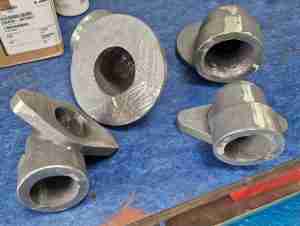 Cast Elbows: Smoke box side elbows in the background, those in the foreground are for the vacuum pipe near the buffer beam
It has been one of those times when getting deliveries is hard. Cast iron elbows for smokebox sides and for the front end vacuum pipe await our inspection, so at least one job is reasonably near promised schedule. The cab corner support brackets are expected back within a few days now. Our contractors purchased a new tool to machine out some bolt holes, but sadly it could only take very light cuts so was unviable. We have now agreed to the manufacture of inserts to be welded into enlarged holes. These will take countersunk bolts, giving the all-important clearance to the rear driving wheels. We d expect to fit them early next week, then fit the coupling rod splashers and start modifications to the main splasher.
On another front, long-term supporters will remember that some years ago we had coupling rod forgings made. These were made of an pretty good grade of engineering steel. We had to buy a ingot, and we have now received a cost for producing forgings for the connecting rods from that ingot. Suffice it to say that the cost is staggering, reflecting the calamitous imposed cost of gas over the last few years. The Trustees will consider the options next week.
Hopefully our trailing hornblocks will be delivered this month, several months late.
The Trust is delighted to report that at its AGM yesterday it accepted Nigel Hunt’s offer to take on the office of Trust Secretary. Nigel is a retired accountant and a lifelong railway enthusiast. He is a keen modeller, has numerous 2mm scale LNWR locomotives and has made and sold kits.
Thank you Nigel for offering your services!
We just about got lucky with the weather on Saturday, there were only a few spots of rain. Our locomotive was wheeled out for display by about 9,30, and the tent straightened up so that those items not fitted to the locomotive could be diplayed. The LNWR Society had a stand, and the Advanced Steam Technology Trust’s 10¼” gauge Evolution, designed for testing new ideas was on display inside the workshop. Facilities for DIY hot drinks were set out, and the show was ready. Amongst our visitors we welcomed Jamie’s apprentice Dan, and work experience student Kobe, with their families. We had some very intertesting discussions with visitors, including our friends on the Clan, and from Diamond Group. While visitor traffic was light, we had half expected that as advertising had been limited to avoid excessive numbers on a small site.
With the experience of Saturday’s event we will be better equipped to repeat the event next year, when our locomotive should have its footplating and cab fitted, and its cylinder block.
It takes quite an effort to put these displays on, abut it is essential that we show our wares. Thanks to our volunteers and to the Keyte Smith team for their sterling efforts.
Sometimes tangible benefits come long after the event. We were delighted to recieve an unexpected donation from the organising committee of The Greatest Gathering last year, as distribution of their final funds.
Being rather busy, we have few photographs from Saturday, but here are two, courtesy of Nigel Hunt.
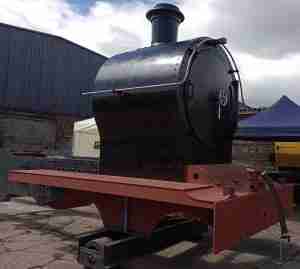
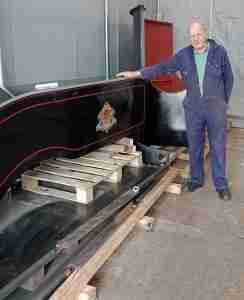
Boro Foundry have posted a video of their manufacture of our vacuum pipe swan neck that fits on the front buffer beam. As made by the LNWR this was an iron casting, requiring a wooden pattern and core box. By using 3D printing instead of traditional methods they saved hundreds of pounds.
Keyte Smith machined the casting, which was tricky because the complexity of the shape provided no easy way to hold the casting while machining it.
Watch the video here and you will see how Jamie Keyte resolved the problem.

Today we put our newly repainted smokebox in place on our locomotive. As ever, there were one or two snags, temporary stiffeners needed a little bit of fettling to clear the frame plates. We anticipate at least one, and perhaps two deliveries over the next few days so we can add a little more before the open day on 16th May. It would be nice to see the trailing hornblocks and rear cab corner brackets that support the coupling rod splashers and cab. We will also be showing our plans for the cylinders, our next big project after our current round of contracts for platework to complete the superstructure.
Hoping to see as many of our you as possible on the day.
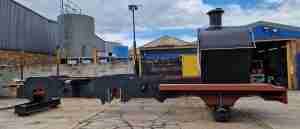
Our Open Day is upon us soon, Saturday 16th April 10am till 4pm at Keyte Smith Ltd, Byron Avenue, Lowmoor Road, Kirkby in Ashfield NG17 7LA. Our smokebox has been rubbed down ready for a coat of black heat-resistant paint before being mounted back on the frames. Hopefully the left side coupling rod splasher, main splasher and lower cab side can all be fitted for the occasion.
It has been a busy time, with the Hengist/B17 Open Day followed by a meeting of the invaluable Main Line Steam Builders Group, and the LNWR Society’s Waverley Gathering last Saturday.
Tomorrow there is a visit to one of our suppliers to ensure we all read from the same hymn book. Then it’s back to cylinder design, a big job that will take some time.
It all brings closer the day when the first fire is lit in No. 2013 Prince George!

Front end platework fitted. The top of the right side driving hornblock visible near the centre of the picture
A joint Keyte Smith/Trust team made a start on getting the platework assembled to the frames, with the front parts now refurbished, blasted clean and given a fresh coat of red oxide primer. Care was needed to get the right fasteners for each hole group, that short length took 4 different lengths of M16 bolt! After a bite of lunch the was a choice to make: fit the smokebox or make a trial fit of the driving hornblocks. Hornblocks it was, and we tried them up with that mix of excitement and trepidation that always goes with a first fit. Excitement that the long-anticipated creation is coming to fulfilment, and a fear that it may expose some calamitous error. All was well, and the two hornblocks were left in place with temporary bolts. It was then time to pack up and prepare for the Clan/CTL Seal (now Diamond Group) open day tomorrow. Apparantly the food van has cancelled, but fortunately my lunch is prepared in its box. Admittedly it was prepared for today, but got left behind on the worktop!

Looking down the centre of the frames, Driving Hornblocks in middle distance, frame stretcher behind
The smokebox will be fitted soon.
We will have our stand at the Open Day at Diamond Group’s Works, Butterthwaite Lane S35 9WA on this coming Saturday, 11th April. The Clan, B17 and many other groups will be there. We would love to see as many of you as possible there to discuss progress, review photographs and future plans. IOt will be a good warm-up for our own open day on 16th May at Kirkby-in Ashfield, where you will be able to get up close to our locomotive.
On Friday we intend to start re-assembling parts on to our locomotive. There may be a few newly printed photographs to show on Saturday!
In anticipation of refitting the front end running plates and smokebox next week, it was off the Kirkby in Ashfield this afternoon to count nuts and bolts to check we have sufficient for the job. There was also the matter of repairing the tent before the promised gales, fitting new webbing hold-down straps in place of the broken junk ones supplied with it. No sooner had I changed into overalls than a truck arrived. It wasn’t carrying the half-expected vacuum pipe swan neck from Boro Foundry, but the Driving Hornblocks from Trefoil. That was a pleasant surprise. Next week we hope to reassemble the smokebox and front end running plates on to the frames. It will be as a permanent assembly this time. Now we have to squeeze in the trial fit of our hornblocks, each weighing 165kg, which we look forward to with great excitement and some trepidation.
Keep an eye out here next week to see how we get on.

Two very beefy-looking driving hornblocks as delivered
Having assembled the frames, it’s time to give them a bity of protection. During a persistently damp winter condensation in the tent has been a continual problem. Sheets over the frames have been the only protection we could provide, but with better weather paint can be safely applied. Keyte Smith’s apprentice Dan and work experience Kobe apply locally-made Dacrylate primer. Dacrylate have been awarded a Royal Warrant, and are a very reputable company.

Having done the chore of painting, the lads are now working on the manufacture of the four smokebox door dogs. These clamp the perimeter of the smokebox door to the front of the smokebox. Made as forgings by the hundred, the LNWR could afford to make expensive dies so the unit cost was minimal. Our alternative means of making them is to machine them from solid using the modern computer-controlled milling machine. As they lack any significant flat surfaces, careful planning of the process is essential. The lads need to produce a 3-D CAD model, translate it into the machine’s system and then set it to work. Keyte Smith is helping train the next generation of engineers, with the full support of the Trust.
On another front, design work has produced a first draft 3-D CAD model of the cylinder casting. More on that later!
We achieved our objective of completing the permanent frame assembly on 4th February. This is quicker than we dared hope when we launched our Frame Assembly appeal in July 2024. In a busy day we installed 199 Huckbolts, at a rate of roughly one every two minutes. Huckbolts are a very secure fastener type, never loosen and fast to install, but as can be seen from the pictures they require a special machine. As the machine was on hire there was an incentive to do the entire job in one hit.

Jamie Keyte instals the first Huckbolt in the joint between front and main frame plates. Tery McMenamin watching

Installed Huckbolts look just like rivets from the outside

The completed frame assembly from the mezzanine floor just above the front buffer beam
Work has now moved on to design and manufacture of cab internal splashers, the right hand coupling rod and main splasher, and refurbishment of existing running plates etc. These will be fitted to the frames as they are completed, so it will be looking like a locomotive again by the summer. After that we will start on the cylinders.
We owe huge thanks to all our donors who have made this possible, loyally giving even though we had relatively little to show for it. Now we have the frames, money becomes more important as storage costs are incurred for such a large item, and of course cylinder castings are far from cheap. So please, if you possibly can afford even £5 per month, go to the home page and click on the donate button.
After a Scottish break including a trip on the Jacobite from Fort William to Mallaig and back and a very wet (Scotch Mist?) cruise on the paddle steamer Waverley, it’s been time to get back to our locomotive.
Yesterday I had a meeting with Alasdair Hibberd, son of our late chairman Paul Hibberd. We caught up with each others’ news and he handed over two number plates that he had been storing for us. We will keep in touch, and hopefully he may be able to visit our locomotive one day.
This morning was spent revising drawings for frame assembly in line with what has actually been done. During assembly we changed the sequence, putting the front buffer beam on as part of the front frame alignment process. The buffer beam and its brackets bring the frame plates to true vertical, giving greater accuracy. This afternoon was spent drilling extra holes and modifying others ready for the final assembly, when we fit over 100 Huckbolts. We will probably have another half day, then two days fitting Huckbolts.
The day when we declare Frame Assembly complete is getting near!
Terry McMenamin
EngineerThe order for our cast steel hornblocks shown below has been placed with Trefoil of Sheffield. Manufacture will be in three stages: making the patterns for the moulds, casting the metal and machining the castings to produce the finished items. Total weight will be about half a ton, and delivery will probably be late January or early February. This is the biggest financial commitment to date, and thanks to the generosity of our Members and donors we have been able to place the order with confidence. Please consider making a donation, the continuing progress after frame assembly depends on it.


CAD Images of our Driving (left) and Trailing (right) Hornblocks
We require two of each
We have also been busy with displays, attending the very busy Barrow Hill Gala on Saturday. If anyone can help with these events, please volunteer. You will meet a lot of very decent people amongst the organisers and the visitors are great. Don’t be shy, come and join jus!
Today was again good enough that we could move our loco frames out into the open for another work session. First task after setting the frames on stands was to set the cross level at or near the driving horns, the trailing horns and near the buffer beam. This time we used a length of bright bar inserted in a hole in the frame plate to the same position hole in the opposite side plate. Note that left and right side plates were welded together for drilling, virtually eliminating any discrepancy side to side. We took care to mark the bar where it entered the hole and the top position to ensure consistency, although we tried turning the bar and it made next to no difference on the reading of our precision level. Having adjusted the front right hand plate and secured it with temporary bolts, we were pleased to find negligible cross-level differences.
In the absence of a cylinder block there is a long length of unsupported frame plate at the front. To keep the front end true have the buffer beam and its brackets, angles and a diaphragm plate. The buffer brackets are pretty massive, and after some debate we opted to assemble them on to the buffer beam lying front face down. This worked well, as can be seen below. When the assembly was lifted using the central sling seen in the photo it balanced quite well. Fitting it to the frames was a juggling act as every fastener goes from the outside of the buffer bracket through the frame plate and a substantial backing angle. Once bolts were tightened up the assembly was true and level still. The diaphragm plate that goes behind the buffer beam and between the frame plates fitted perfectly.

Next we moved to fit the boiler slides. Unfortunately we found our contractor had flame-cut the fastener holes and it needs a bit of extra work. However, Old Father Time said not today chaps. It was time to finish for the day, so we tidied up and put the frame assembly back in its tent. Today’s work has created a very big difference in the appearance of the locomotive, and we can be well satisfied with the results.
As ever, we owe a big thank you to the Keyte Smith team who have been brilliant.
Finally a reminder that building this iconic locomotive requires money, all of our funds come from voluntary donations and Trustees are unpaid. Please support our project financially or by volunteering.

Today being a glorious autumn day, our frame assembly was moved out into the open air, giving us more room to work. The plan was to align the front frame plates to the main frame assembly and attach the various brackets and angles etc ready for fastening permanently another day. We were making good progress until we discovered that dowel holes were oversize in the front frame plates, and worse, one appeared to be slightly off position. After much debate and trying to find true surfaces on the front plates we finally aligned them using the other holes after levelling the frames all round, then bolted the plates together. We will confirm alignment next week by directly measuring cross-levels of holes in the front frames using bright bar. The holes are the critical features, son we have to measure these directly.
We had more luck with the brake hanger pivot brackets just delivered from Boro Foundry. The 50mm spigots were a medium driving fit in the 50mm holes in the main frame plates just as intended. Boro also drilled the holes in the main frame plates a few years back, so they got both jobs right.
There was just enough time to bolt the rear cab support outriggers and splasher brackets in place before packing up for the day. Another day will be needed before everything is finally fastened together on 8th & 9th October.
There will be more news next week. A new significant order is in the offing, so keep an eye out and please remember all this costs money. If you possibly can consider joining us for £5/month minimum or make a one-off donation.

Front Frame Plate set up flat for reaming. The hole was already over size!

Ready to go back into the Tent
It’s autumn, and and after the excitement of The Greatest Gathering and our holidays we are back to work. All parts of stage 2 of frame assembly are made, and plans for the actual assembly work are at an advanced stage. Some tools and equipment need to be purchased over the next few days, and the first part of the work will be carried out on 25th September. That will see the front frame plates fully aligned to the main frame assembly, with temporary fastenings. The miscellany of angles, channels and other parts for the front end structure will be cleaned up and final permanent assembly will take place on 8th & 9th October. This will mark completion of Frame Assembly, the subject of our appeal announced in July 2024 at Kidderminster. Progress has been better than expected, it will have taken only 15 months, thanks to the generosity of our donors.
Our next stage of the build is being planned, with progress towards a very significant order being placed soon, and further plans as well. Of course this will require more funds, so if you will the build of Prince George please consider helping see our DONATE page.
Further news shortly!
The Greatest Gathering is all finished now. After the hard work preparing the displays, it only took an hour or two for all bar the biggest items to be taken down and removed. It has been a great three days, talking to the visitors and explaining the significance of the George in terms of its technical advances, and of course the reason for the Union Flag and bunting we put up to mark Prince George’s twelfth birthday just 12 days ago. The banner to the right of our front end shows the link to the naming of the first of this class of LNWR locomotives after Prince George’s great-great-great grandfather.
Our display was sandwiched between two LNWR Society stands, the one to the right showed several 5 inch gauge live steam locomotives and wagons. We greatly appreciated their presence and the mutual assistance, helped by most of us being members of both the Trust and the LNWRS. We must also record our thanks for the sterling efforts of Jamie Keyte in helping prepare and transport our exhibit.
Most of our flyers advertising our project were distributed, and we have won some new recruits to help us along. In the best railway tradition, our Engineer made contact with former colleagues, and renewed acquaintance with other groups, including another 4-4-0. On Saturday night a group of 10 made up mainly of our own team and Advanced Steam Technology Trust Supporters enjoyed a meal at our Engineer’s local pub.
It has been a very tiring three days, but very rewarding and we feel very privileged to have taken part.
Our Engineer will be taking a break during August, so there will be no more postings for a while. We look forward to completing frame assembly in September, and certainly there will be posts about that.

The Greatest Gathering at Alstom’s Derby plant, once known as Derby Carriage and Wagon Works, is getting very close.
Jamie Keyte and daughter Ella delivered our smokebox and front end plinth and our LNWR toolbox today, and dressed it with a flag and bunting to mark Prince George’s recent 12th birthday. More is to come on Thursday, we will have a large banner and our photo display. Jamie has an album of photographs of the build from its early days, which is very interesting.
Our stand is right at the end of U shop, strategically placed so that people can see our display from the other end.
It’s going to be a great show, and we look forward to seeing as many of you as can get there.


Prince George
Credit: X/@KensingtonRoyal
Today is the Twelfth Birthday of His Royal Highness Prince George.
Our Trustees wish him a very happy birthday.
Our supporters will know the story, that as the first of the Class was named after King George soon after his accession to the throne, the Trust was honoured with permission for our locomotive’s number to be 2013 and its name Prince George. It is fitting that our locomotive is named after King George the Fifth’s great-great-great grandson.
In a few days time we will be at The Greatest Gathering at Alstom Derby displaying our front end with suitable bunting in recognition of his birthday.
 Our friends and contractors at Keyte Smith Ltd have been busy with their machining centre reducing solid metal blocks to reverser shaft brackets. The reverser shaft fits between the frames and has curved guides to operate the valves. It is tilted one way to drive the engine forward, and the opposite way to drive it tender-first. The original LNWR brackets were a steel forging, standard across hundreds of engines so quite economical at the time.
We only need two, and forging is not much used today, being quite expensive even with a good production run. For today’s world and to make just two the bracket has been re-invented. While it may seem wasteful, all the material removed is collected and eventually remanufactured as new steel products.
We have a slide show of 9 slides to show the manufacturing steps. look for the menu bar on opening the file and click the up/down arrows to scroll through the slides.


Delivery of parts for our full frame assembly continues with the two front buffer beam brackets made by CTL Seal. The LNWR version was a steel casting and because we only needed one right and one left hand version we couldn’t justify the pattern-making cost. CTL Seal have made these as welded steel fabrications, with some minor alterations to suit the present day reduced buffer height.
Other parts are in the pipeline, but our focus for now is on our display for The Greatest Gathering at Alstom Derby, just 15 days away.
More news soon!
Followers will have noticed a lack of postings since the frame assembly day. Our engineer has unfortunately broken a leg, doing a proper job requiring a 3½ hour operation. He is now hobbling about the house and gently starting to progress work again. Over the next week or so he will be finalising drawings so that we can order the last few parts required for second stage frame assembly.
Activity will pick up again very shortly.
With the the team at Keyte Smith, a hard but enjoyable day was spent on the first stage of frame assembly. This has fixed the basic frame alignment for the life of the locomotive, short of a major rebuild. Watch Our Slide Show (15 slides) here

Main Frame Plates, Dragbox, Motion Plate & Frame Stretcher are now bolted up, marking a critical step forward. Any errors in aligning the frame plates can only be remedied by a major strip-down and rebuild, so this had to be done correctly. A great help has been the accuracy of modern machine tools and modern metrology (the science of measurement). Parts supply by CTL Seal and Boro Foundry fitted perfectly, with Coordinate Measuring Machine (CMM) output of the dragbox from CTL Seal giving us the confidence to use that to achieve alignment.
Thanks to our contractors Keyte Smith Ltd, and our suppliers.
We will be planning another work day to tie up some loose ends and to align the front frame plates to the main assembly.
A great day’s work!
Today we took delivery of the final fourteen items needed for frame assembly tomorrow. Almost anyway, a fibre pad to remove rust and paint wasn’t in stock, so that will be collected first thing in the morning. The 14 items include various sizes and strength grades of bolts, nuts and washers so we hope we have got everything right.
Must set the alarm and take time for a good breakfast. Weetabix, Porridge, Shredded Wheat or What? Descisions decisions!
Preparations are well advanced for our Frame Assembly, scheduled to start on 22nd May. Our Dragbox is now paid for and on site, our bank showed funds unaffected by the payment. Our treasurer took a closer look and found that a very generous donor had given enough to cover the dragbox with a little change. Thank you so much for that, you know who you are! We have raised orders for all the minutiae needed, nuts and bolts, thread inserts, even marker pens. A precision level for levelling the frame is shown below, next to a standard trade level. The latter shows level, perhaps with a slight indication that the left might be a tad higher, but the precision level shows the left end is very definitely higher.
Thanks to our generous donor, we can now order all the parts needed for frame assembly, various steel angles and some very large ones, some minor platework and such like. We have already placed an order for two reverser shaft bearing brackets, to be machined from solid as that’s more economical than making a pattern, casting two parts and machining them. Things have changed, but remember we are building one locomotive only.
It’s getting exciting!

On Friday 9th May we had the pleasure of meeting a group of members of the Hertford U3a. It was good to meet such a sociable and interesting group of people, some railway enthusiasts and some not, but all were keen to hear about our Loco Prince George,
Thanks to Hertford U3a for the invitation to make the presentation, and thank you too for the ample supply of tea, absolutely essential.
Should you want to request a talk for your organisation or group, please email secretary@:newprincegeorgesteam.org.ukJamie has made a set of 6 frame stands for use during frame assembly. A lick of paint is all they need now, a first coat would have been applied today but local traffic was so bad that it was more sensible to leave it till another day.
The adjuster nut is M48, for which we need a 75mm spanner. This is not found in the average tool box, and one reputable manufacturer’s website quoted £682. In accordance with the spirit of Sir Richard Moon we found one for a twentieth of that price!
We look forward to putting the stands to good use during May and June. Everything for Frame Assembly should be to hand in a week or two.


Our Publicity Officer Dave Costello Manning the Stand
The TCL Seal open day at Sheffield was very busy today, with several hundred visitors. Our newly completed dragbox provided a talking point, as a good example of how we have adapted an original 1910 production cast iron design as a one-off welded fabrication for manufacture in today’s world. With good numbers of people coming in we were kept busy Quite a few weren’t aware of our project and it was good to be able to update them .
It was good to see our friends from the Clan, B17 and GCR 567 projects as well as a number of model engineers’ groups and railway modellers.
It was a very good day. Our thanks to TCLSeal and the Clan/Hengist organisers for their work and letting us shows our wares.
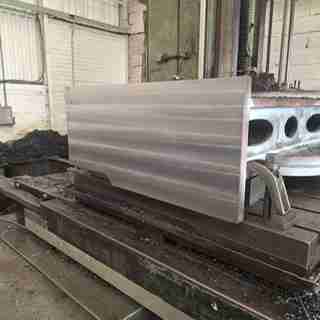
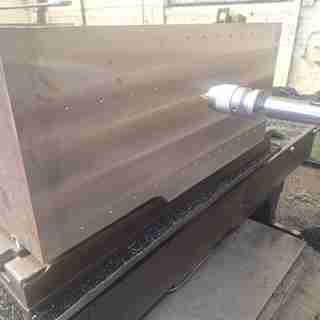
TCL Seal are nearing the finishing line with our dragbox. The photographs show it after facing the sides (top), starting the drilling of the bolt holes (lower) and with one side fully drilled (bottom). The completed dragbox will be on display in Sheffield at the Clan/B17 Open Day on Saturday 12th, from 10 till 4. Do visit if you can, we’ll be delighted to talk to you there.
We have issued a new order for TCL Seal to manufacture the buffer brackets, and another to Boro Foundry for the brake hanger pivots.
It’s all happening, and we can’t wait to get these materials into our frames!
Please, if you can afford it, consider a donation, or become a member from only £5/month to support our continuing progress.
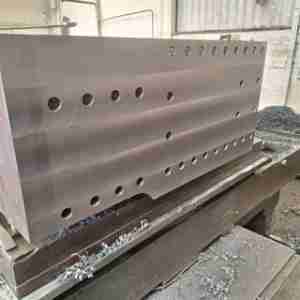

Thursday 27th April 2025 was another important milestone for our locomotive. The locomotive as exhibited at Crewe Heritage Centre in 2023-4 (above) was stripped down to the bare main frame assembly and the front frame plates were trial fitted (below). Everything removed was saved for possible re-use, including the plinth that was incorporated to support the locomotive’s smokebox pending delivery of the front frame plates. That is being saved for the Greatest Gathering in August.

To see the day’s work click SlideShow
Our dragbox is seen below, nearing completion. It is fully welded, and the heavy plates require equally heavy welds, which contract on cooling causing localised stress. This is eased by stress relieving, with the dragbox carefully heated in a furnace to a controlled temperature. The white marking around the welds is from magnetic particle inspection, in which “ink” loaded with iron filings is painted on to the welds and the metal is magnetised. Any flaw causes the concentration of the iron around it, more easily seen against the light background.
The final operation will be to machine the dragbox sides and the circular ring, drill the bolt holes to for attaching it to the frame plates and for attaching the brake cylinder, with a final dimensional inspection.
It will be displayed at our stand at the Clan & B17 open day on 12th April before delivery to our base at Kirkby in Ashfield.

Our AGM was held last Saturday, 22nd March. As there were no nominations for Chairman or Treasurer, both these posts were left vacant. Derek Buckles will continue as Acting Chairman until a new Chairman can be found, and Terry McMenamin will continue as Acting Secretary for the time being. We really do need volunteers for these posts, and it’s much better if we can act as buddy for a changeover period. Please consider volunteering.
Finances are healthy, but we do have open orders for about £23k including VAT, and the invoices can be expected soon. We also need an estimated £15k -£16k for this year’s frame assembly, and we need to raise extra funds for that.
Our team is now working on its forthcoming public events, at TCL Seal Sheffield where we join the Clan, B17 and GCR 567 projects on their open day, 12th April. We will also be at the Greatest Gathering event, at Alstom’s Litchurch Lane Works Derby, part of the Rail200 celebrations. There will be more on those events very shortly. If there is sufficient interest we will plan our own open day too.
 Goodman Metals of Nottingham have delivered our front frame plates drilled ready to assemble on to the main plates. They are stored flat lying alongside our locomotive in its tent. The parts on the left leaning against the locomotive are from the “piano front” in front of the smokebox, so stripping down the locomotive has started in a small way. We plan to choose a good day and strip it in one go.
Other preparations include a large torque wrench delivered last week. We managed to save several hundred pounds on this tool by shopping around. It will ensure that bolts are tightened to the specified degree. Fasteners are ordered, with one more small batch to order. We are seeking prices for brake hanger pivots, the last items needed for first stage frame assembly.
HEAVY METAL!
Dragbox Manufacture
TCL Seal are busy welding our dragbox together in their Sheffield works. This is a great demonstration of their engineering skills.

Looking towards the rear of the dragbox
It is inverted, showing the “H” section housing the drawbar pivot
In the left background is the bottom plate with the cut-outs, and the ring that will support the steam brake cylinder.

Rear/side view
The dragbox will weigh almost a ton when complete. Its machining will be sufficiently accurate that it can be used with other supports and guides as a frame assembly guide. We can’t wait to start putting it into the frame assembly!
After three days of hard work in the freezing cold winds this week we have been able to create a shelter for our locomotive. It’s an industrial tent 6m by 12m by 4m high to the eaves. Erecting the frame work for the roof (below left) was relatively straightforward apart from an apparent error with bracing struts, but we have managed to assemble it. Getting the cover on was interesting, with a heavy sheet about 12.5m by 15m with no markings for the apex or to differentiate gable end edges from sides, and folded tightly for packing so the fabric was sticking to itself. A video shows two people lifting one side of a smaller tent to insert the two-piece tubular support legs, but as can be seen at lower right, we needed two machines and at times had 4 people on it. By the end of day two we had it up, with just enough fastenings to the concrete and ties to the covering sheet to be secure in the relatively quiet conditions. Today we got the wrinkles out of the covering sheet, the framework secured to the concrete and got the cover snugged down to the tubular framework.


Time and the rising wind made it inadvisable to put the ends on the tent, but as you can see below left we were able to manoeuvre Prince George under shelter where she will be for some time to come while we build the frame assembly. Completion of the tent will be dependent on reasonably quiet weather.

Prince George under shelter

Motion plate and frame stretcher ready for assembly
Looking forward to the future, we have the motion plate and frame stretcher to hand (right), the front frames and the dragbox are coming on well, so we have much to look forward to. More on that shortly.


Being towed into loading position Ready for the road
Today our locomotive No. 2013 Prince George has moved. After two seasons on display at Crewe Heritage Centre we needed a site where we can get on with the build. Our long-term allies at Keyte Smith Ltd offered to rent some hard standing to us, with permission to erect an industrial tent as our erecting shop. Our haulier, J Swingler, offered to do the move at a bargain price today, so this morning I had to jump into the car and drive to the Heritage Centre, arriving just behind the low loader at 10 this morning. There was a bit of debate about how to turn the engine round for loading chimney first, till our driver Danny told us he could fit a front towbar to the tractor unit and tow it out to a suitable position. Everyone agreed, the rain came on and we suffered it while the tractor unit was unhitched and our loco was towed out. Once in position, the tractor was hitched up to the trailer and the loco winched up and secured down. Between the rain and the extra operations to tow the loco out, it took a full 2½ hours, and a warming cup of tea was required before hitting the road.
Your writer cunningly avoided the unloading operation by calling to buy some finger food. Trying to avoid queues, a navigational error meant that the unloading was complete on arrival. It only remained to remove name and number plates for security, and move the loco to its allocated patch. In view of forecast winds (and the cold!) it was decided to leave fitting the tarpaulin till another day.
We are very grateful to all at Crewe who were involved with the display of the locomotive, particularly its arrival and departure. Out low loader driver Danny did an excellent job, and above all our thanks are owed to Jamie and Paul at Keyte Smith ltd.


Arrival at Kirkby in Ashfield In the allocated position
The tent to protect the locomotive is now in the hands of the German carrier, so we hope to have that soon.
Other news is that our motion plate and frame stretcher are complete ready for delivery as soon as we are ready. Erecting the tent must take first priority, but possibly in a month’s time we will see them bolted up between the frames.
More news shortly!
Thanks to the generosity of author David Knapman as the Trust was delighted to receive an unusual Christmas gift, comprising 11 prints of locomotive general arrangements from contemporary issues of the trade magazine “Engineering”. The subjects range from North London Railway 4-4-0T and 0-6-0 through most of the Webb three-cylinder compounds, the four cylinder compound “Black Prince”, through to Cooke’s 4-6-2T and Claughton, and finally a North British drawing of the Royal Scot.
David’s books are listed on the Pen and Sword website. His next book is due shortly, keep an eye out.
We will be checking whether these drawings are already on the LNWR Society archive, and arranging scanning of those not already there. After ensuring they are all available in digital form we will consider how best to use them to raise funds for the Trust,
For the time being we must prioritise work on our move from Crewe Heritage Centre. While we will be sorry to leave, we need to be able to work on building the locomotive. Great things are afoot, expect exciting news soon!